

A Local's Guide to Shopping a Saturday Farmers Market
A practical guide to shopping a Saturday farmers market: when to arrive, what to ask growers, how to pick good produce, and how to keep the budget in check.
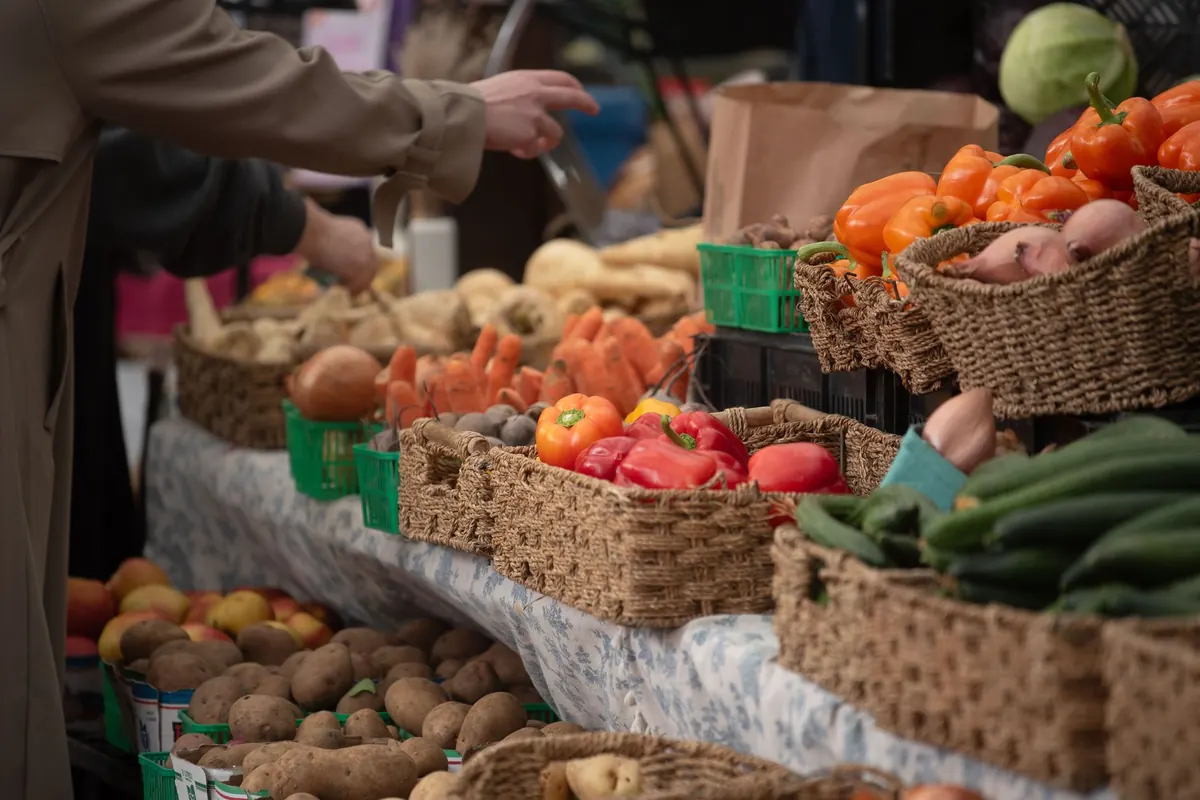
A Saturday farmers market is one of the few errands worth slowing down for. But wandering and shopping well are different skills. The people who leave with a full bag and money still in their pocket tend to share a few habits: they arrive at a sensible hour, they walk the whole market before buying anything, and they know which questions get a straight answer. None of it is complicated. It just has to become routine.
Arrive With a Rough Plan and a Little Cash
Go knowing roughly what you need. Not a rigid list — markets punish rigid lists — but a sense of how many dinners you are actually cooking and what is already sitting in the fridge. If you have half a cabbage and a bag of potatoes at home, that changes what is worth buying. If you are out of oil, onions, and coffee, that changes it again.
What to bring:
- Cash, including small bills. Many vendors take cards now, but cash moves faster and helps you feel the budget in your hand.
- A sturdy tote plus one smaller bag for berries, eggs, or anything that bruises.
- A cooler bag in warm months, especially if you have a long walk or a second errand afterward.
- A little empty space. Impulse buys are half the pleasure of a market.
On timing: early is for selection, late is for bargains. In the first hour you get the best of everything and the shortest lines; in the last half hour you get the leftovers, sometimes at a discount, and vendors who are tired and happy to talk. Decide which one you want more. If you are shopping for a specific dish, go early. If you are shopping to be surprised, go late.
Walk the Whole Market Before You Buy Anything
Do two laps. The first lap is nothing but looking: who has the best tomatoes, who has eggs past noon, what the prices look like at the stall by the entrance versus the one at the far end. You will almost always find two vendors selling the same thing, and the difference in quality is worth the extra fifty steps.
The second lap is for buying. Start with the heavy items at the bottom of the bag, finish with the fragile ones, and leave the things you are unsure about for the walk back. If you see something spectacular on lap one that is clearly the best of its kind, buy it then. Nobody ever regretted buying the good peaches.
Read the Stall, Not Just the Sign
Signs are marketing. Questions are information. Market rules vary from place to place — some require vendors to label what they grew themselves, some allow resellers, some do not — so the fastest way to know what you are buying is to ask directly.
- Did you grow this? A grower answers in details: the field, the weather, the variety.
- When was it picked? "This morning" and "last week" are very different answers.
- What is best right now? This is the single most useful question at any stall.
- How do you cook this? Vendors know how their own food behaves in a pan.
A stall with twelve items is not automatically better than one with forty, especially in late summer when everything is coming in at once. What matters is whether the person behind the table can tell you where each thing came from.
How to Pick the Good Stuff
You do not need to squeeze everything in sight. A few reliable checks will do most of the work.
- Tomatoes: heavy for their size, fragrant at the stem end, shoulders that give slightly. Skip anything cold and hard.
- Stone fruit: smell it. A peach that smells like a peach tastes like one. Firm is fine if you plan to eat it in two days.
- Berries: look at the bottom of the container, not the top. Stained or damp cardboard means crushed fruit underneath.
- Greens and herbs: crisp, no yellowing, stems that snap rather than bend. Buy roughly what you will eat in three days.
- Corn: tight husks, brown silk, and ask whether you can peel back one small corner to check the kernels.
- Roots and squash: firm, heavy, no soft spots. Attached greens are a bonus, not a requirement.
For eggs, cheese, meat, and bread, ask the vendor how they store it and how long it keeps. They will tell you more in ten seconds than a label will.
Keeping the Budget Honest
Set a number before you leave the house, in cash, and treat it as the whole budget rather than a starting point. Then split it mentally: most of it for staples, a small piece for one thing you are genuinely excited about. The treat is not the problem. Ten unplanned treats are.
A few habits that stretch the same money further:
- Ask what they are selling as seconds — cosmetically imperfect produce, often at a lower price and just as good for cooking.
- Buy by the case when a crop is at its peak, then freeze, roast, or preserve it. Split a case with a neighbor if it is too much.
- Compare cost per pound rather than per item, especially for anything sold both loose and by the bag.
- Check the market's info booth about benefit programs; many markets accept SNAP/EBT, and some run matching programs that stretch those dollars.
If the pressure goes beyond groceries — debt, a lean month, a bill you cannot plan around — talk to a nonprofit credit counselor or a financial adviser rather than taking money advice from a market blog.
Shop the Season, Not the Recipe
If you walk in wanting tomatoes in May, you will be disappointed and you will overspend. The market's real job is to tell you what time of year it is. Abundance is the signal: when one thing is everywhere and cheap, that is what you should be cooking. Ask what just started, what is about to end, and what they will not have next week. That conversation is worth more than any meal plan.
Make Saturday a Habit
The advantage of a weekly market is repetition. You learn which vendor's greens last longest, which farm's eggs you prefer, and who will set aside a flat of strawberries if you ask on Friday. You get faster at judging, better at budgeting, and less likely to come home with a bag of beautiful things and no plan for dinner.
When you get home, deal with the haul before you sit down. Rinse and dry the greens, keep herbs upright in a glass of water, leave tomatoes on the counter, and put the berries in the fridge unwashed. Twenty minutes of sorting on Saturday is what makes the rest of the week's cooking easy — and what makes next Saturday's trip worth repeating.
Photo: Karen Longwell / Pexels